Integrated
Bindery Systems


 search

Smart News‑binder
For newspaper production
The Smart News‑binder is a special version of the standard IBIS Smart‑binder that includes modifications to produce newspapers up to a maximum size 273mm (10.75") x 457mm (18"), minus any trim required) from digitally-printed newsprint rolls.
Smart News‑binder (SNB) - Maximum sheet and newspaper sizes
Incoming Sheet
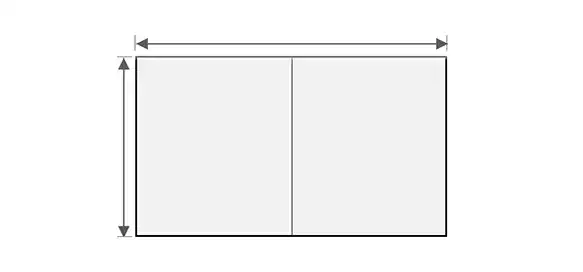
max spine length 320mm (12.6")
max spine length 457mm (18")
Folded newspaper - with trim if required
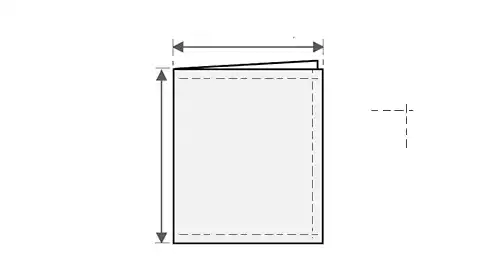
max spine length 320mm (12.6") minus trim
max spine length 457mm (18") minus trim
| Maximum speed | 5,500 newspapers/hour |
| Minimum newsprint paper weight, WITHOUT additional in‑line F‑100 folder | approx. 60 gsm depends on paper quality and speed |
| Minimum newsprint paper weight, WITH additional in‑line F‑100 folder | approx. 40 gsm depends on paper quality and speed |
Smart News‑binder specifications in full
Newspaper production with optional F-100 (or F-200) buckle folding
The F‑100 or F‑200 buckle folder may be added between the web cutter and the SNB as shown below and used to fold each sheet in half.
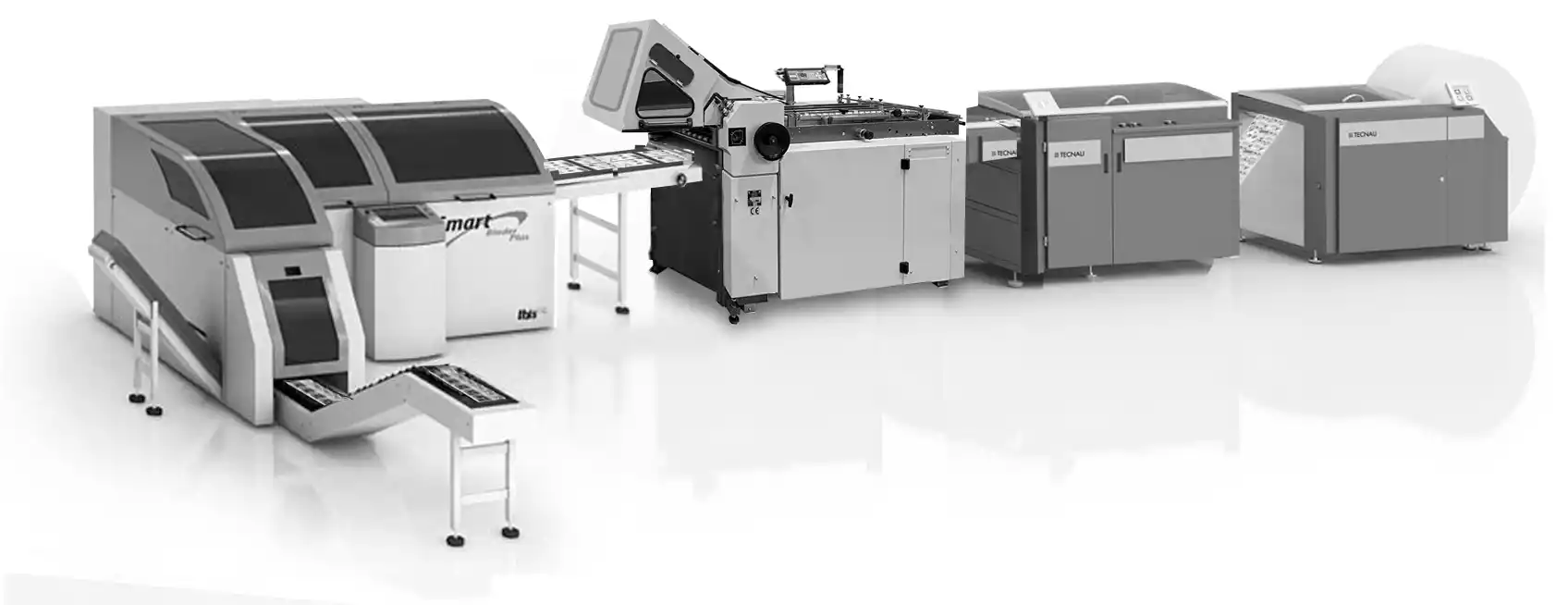
If all sheets are folded using the F‑100 then the newspaper must contain an integral number of 8 pages (8, 16, 24, 32 pp etc). The F-200 selective buckle folder can mix 12pp sheets (folded twice) and 8pp sheets (folded once) within each newspaper to give 4pp increments.
Newspapers may be produced with or without front-edge and head/foot trim. However if the F‑100 or F‑200 folder is used then the head‑side of the newspaper must be trimmed to remove the head-fold.
When using lightweight newsprint stock increased running speeds may be achieved if sheets are buckle-folded before entering the SNB. The additional buckle fold operation is essential if running very lightweight newsprint (less than about 60 gsm stock weight)
Knife folding
Newspapers produced by the SNB may be subsequently folded in half using an in-line knife folder connected to the SNB delivery conveyor.
Production speed
If feeding from a printed web then the newspaper production speed depends on the web speed, the spine length and the number of pages in the newspaper.
If running without the additional F-100 (or F-200) folder then 130 m/min (426 ft/min) web speed is achievable with heavier stock papers, but this speed may need to be reduced if using lightweight newsprint (depending on the paper quality). The additional F‑100 (or F-200) buckle folder allows web speeds to be increased to about 150-180 m/min (492-590 ft/min) even with newsprint stock.
The SNB output speed may be calculated as follows:
| Output speed (newspapers/min) | = | Web speed (in meters/min) x 4 |
| Newspaper spine length (in meters) x number of pages in the newspaper |
Binding options:
Newspapers may be produced with loose folded sheets (no binding), or with up to 4 wire staples, or with dots of PVA cold glue on the spine‑fold (ISG gluing).
Modifications to handle newsprint
Lightweight newsprint stock has much less resistance to ‘collapsing’ compared with normal paper stock when stopped from high speed. To run newsprint reliably the SNB therefore includes additional modifications to reduce static charge and assist high speed sheet collection.